
Renesas RH850.
Three variants. Three segments.
Crossware has extensive delivery experience across the RH850 family — two-wheeler clusters on the D1M1A, industrial vehicle HMI on the D1M1V2, and multi-camera industrial systems on the D1M2H. Graphics stacks ported to both bare-metal and FreeRTOS.
Different silicon, different problem.
Each RH850 variant lands in a different segment with its own constraint. Crossware delivers across all three, in production programmes rather than evaluation projects.
Two-wheeler clusters
The D1M1A is where most of Crossware’s RH850 volume sits. Multiple two-wheeler instrument clusters have been delivered into start of production on this part, for premium and performance motorcycle programmes.
The engineering emphasis here is binary size and rendering performance together. On one production programme Crossware reduced firmware size enough to bring CAN bus flashing under nine minutes — enabling the hardware JPEG decoder, applying delta-frame encoding to animation sequences, and exploiting all four hardware rendering layers to hold 30+ FPS across every screen.
Read the full case study →Industrial vehicle HMI
On the D1M1V2, Crossware delivers HMI for industrial vehicles — a segment with different priorities to automotive: longer service life, harsher operating conditions and displays that are often smaller and lower resolution than a passenger cluster.
Crossware developed a custom graphics port for this variant specifically targeting small-resolution display targets, where the standard configuration carries overhead the application cannot afford.
Multi-camera industrial
The most integration-heavy of the three. Crossware supports an industrial customer on the D1M2H with a system involving multiple camera inputs — bringing several live video sources into an MCU-class HMI, where bandwidth, memory and composition all have to be managed simultaneously.
Screens that shipped.
A cross-section of cluster and HMI work delivered on the RH850 family — performance and commuter two-wheelers, electric drivetrains, and off-highway machine interfaces. Production programmes, not concept renders.
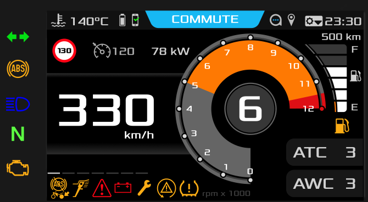
Performance cluster
Sweeping tacho arc, gear indicator, live power output and traction/wheelie control levels, with a full telltale matrix along the base.
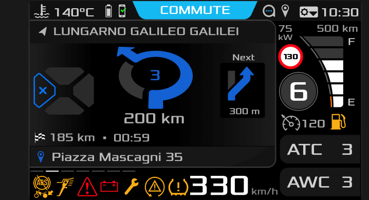
Navigation mode
The same cluster composited into a guidance layout — street name, manoeuvre arrow, distance to next turn — without losing the ride-critical readouts.
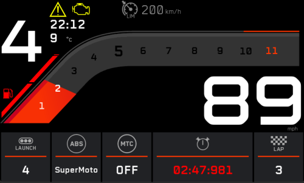
Ride modes & track telemetry
Shift-light tacho ramp, large gear numeral, and a function rail carrying launch control, ABS and traction mode, lap timer and lap count.
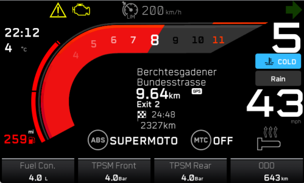
Route guidance & ride data
Named-route guidance with exit and ETA, rain and cold-tyre states, front and rear TPMS, fuel consumption and odometer in one screen.
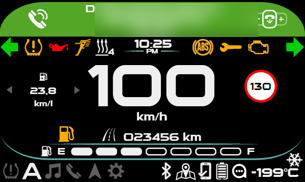
Connected cluster
Incoming-call notification overlaid on the ride view, alongside speed-limit display, consumption, range and a wide connectivity telltale row.
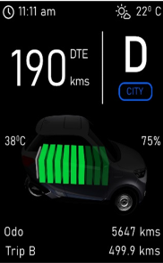
Range & battery state
Distance-to-empty as the primary readout, drive and city mode selection, pack-level state of charge and dual trip meters.
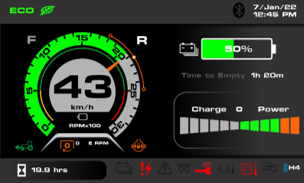
Charge & power flow
Bidirectional charge/power bar around a central speed readout, with state of charge, time-to-empty estimation and operating-hour tracking.
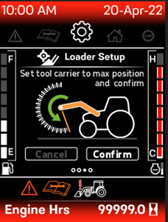
Loader tool-carrier setup
Guided setup dialog with confirm/cancel flow and live machine graphic feedback, framed by hydraulic and thermal gauges and engine-hour tracking.
What Crossware does on the platform.
Graphics stack porting
- Porting graphics stacks onto RH850 hardware
- Bare-metal and FreeRTOS — both delivered in production
- Hardware JPEG decoder enablement
- Display and panel bring-up
Cluster & HMI application
- Instrument cluster development end to end
- Hardware layer composition strategy
- Multi-camera input integration
- CAN and vehicle signal integration
Size & performance
- Binary size reduction for CAN flash windows
- Delta-frame encoding for animation sequences
- Asset format, compression and font subsetting
- Frame-rate profiling on target hardware
Validation
- Hardware-in-the-loop testing on target
- Frame rate and CPU load measurement
- CAN simulation and signal testing
- Release validation and reporting
Go deeper on RH850.
Motorcycle cluster on RH850
CAN flash time brought under nine minutes through JPEG decode and delta-frame encoding.
TechnologyQt for MCUs at Crossware
Day-one involvement, R&D contribution and 10+ automotive products into SOP.
PlatformsAll hardware platforms
Application processors, automotive MCUs and AI accelerators Crossware delivers on.
Tell us the variant and the constraint.
Whether it is flash budget, frame rate, camera integration or a port onto bare-metal, Crossware has shipped it on this family.